As of January 2027, I am an Assistant Professor in the Department of Computer Science and Engineering at the University of Notre Dame. ☘️
I run the Ditto Lab (David’s Intelligent Team Tackling AutOnomy). This name takes inspiration from Daphne Koller’s and Stephen Bach’s group names (and Pokémon of course).
We are interested in enabling robots to do general-purpose tasks much like we humans do. 
More about me: [Research Statement] [Teaching Philosophy] [Diversity Statement]
Application deadline: *Dec 15, *
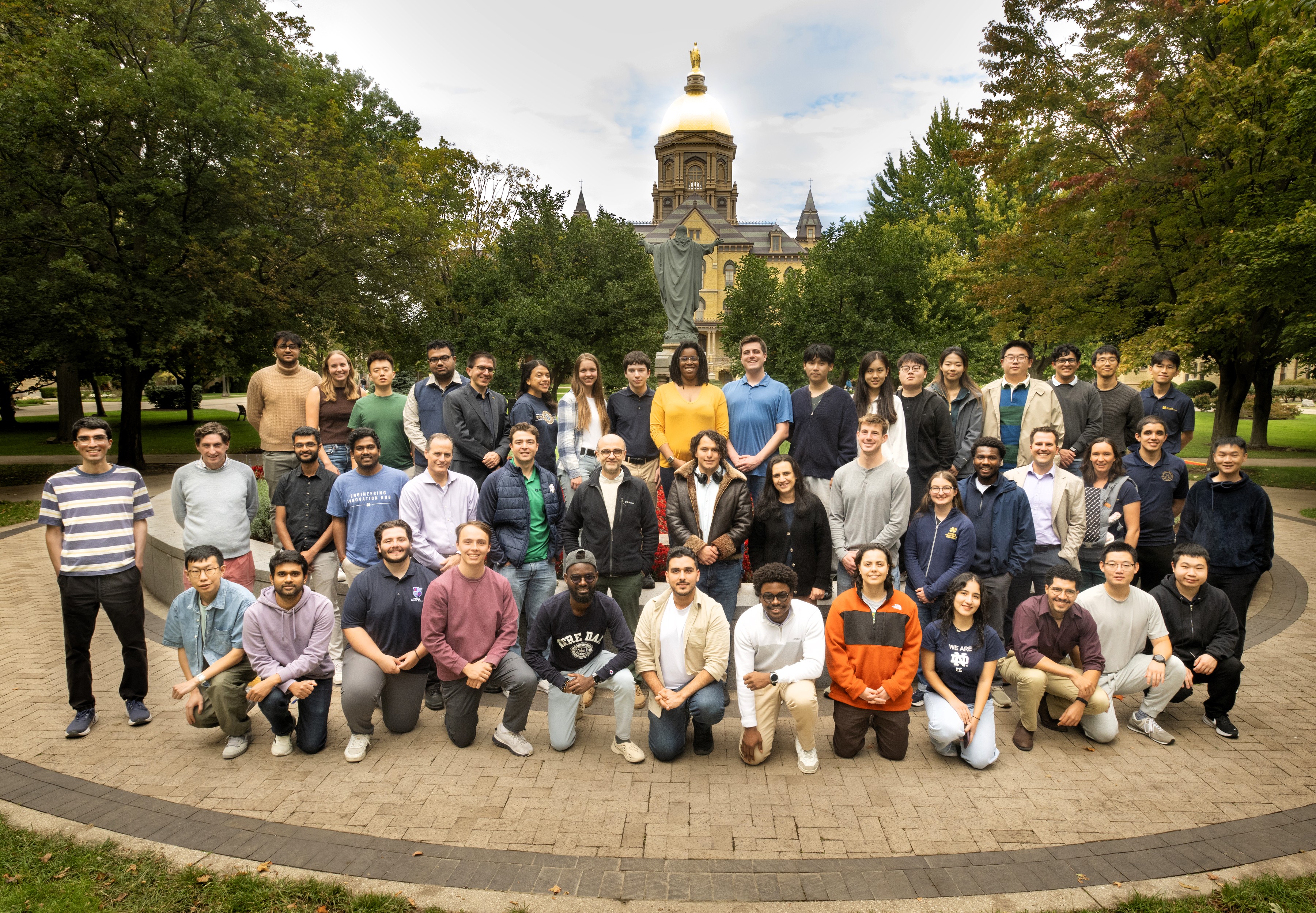
Pictured above: Group Photo of Robotics@ND faculty and students (should be large but folks were missing 🙂; taken in Fall 2026)
Research Interests 🔍
My lab focuses on the use and applications of AI methods for general-purpose robotics. Rather than building robots (like my colleagues in other departments), we use commercially available robots (robot arms, humanoids, etc.) as platforms to test and evaluate our methods. Robotics is an exciting field for realizing embodied AI, as we focus on how artificially intelligent agents can perceive and interact with the physical world.
Lab Mission: To develop robots that can reason about their actions and the world around them while leveraging commonsense knowledge from text, images, and other modalities, as well as from prior experiences (now typically captured by world models and foundation models). Please see my research statement for a brief overview of my research philosophy and long-term goals, and check out my Google Scholar for my papers.
Our research explores the following themes (click each to expand).
Planning: task and motion planning (TAMP), object-level planning, world models, foundation models, agentic robotics.
- How do we formulate an instance of a planning problem often in the context of hierarchical planning—for instance, from object-level to task- and motion-level planning?
- What abstractions are useful when formulating such problems?
- What are essential components of a world model? How can we leverage image-based world models for imagining the consequences of actions or future states?
- How can we bridge symbolic and latent structures?
- How can we make TAMP more accessible (i.e., easy to use, reliable, and portable)?
Acting: robot learning for skills (machine learning, foundation models, vision-language-action (VLA) models), parameterized skills, generalization, (inter)active perception, language grounding.
- Given a plan (whether detailed or abstract), how does a robot execute and solve it with its skills?
- How can the robot adapt when things go wrong (if skills fail, objects are missing, or the environment changes)?
- Where do robot skills come from? Are they agent-designed, learned from demonstration and captured by machine learning models, or pre-programmed action primitives?
- How can we specify or identify the characteristics of skills from the context of Markov decision processes (MDPs) or higher-level options? For example, what are the initiation set (preconditions) and termination conditions (effects/post-conditions) of a skill?
- How can we use existing policies or skills to learn more complex behaviours never seen before? How can we use knowledge from foundation models as a curriculum or scaffolding to do this?
- How can we leverage off-the-shelf models for interactive perception?
Interfaces and Applications: human-robot collaboration (HRC), human-robot interaction (HRI), domestic robots, assistive robotics, human-in-the-loop (HITL), AI for Science, explainable AI (XAI).
- How can robots interact or collaborate with humans?
- How can hierarchical planning frameworks be adapted to different domains, such as our homes, labs, or in the wild?
- What roles can human feedback, preferences, and values play in hierarchical planning and acting? How can we best communicate the robot’s capabilities and limitations to humans?
- How can we realize the vision of an autonomous generalist scientist from the robotics perspective?
If any of these things sound interesting to you, please continue reading to learn more about joining the lab!
Joining the Lab 🦾
Prospective PhD Students: Note the following instructions.
- Apply directly to the Notre Dame PhD program. Please mention my name (David Paulius) as a potential advisor in your application.
- I plan to reach out to prospective candidates after the PhD application deadline (December 15, 2026). Please look out for any emails after that; I’d be more than happy to chat with you to discuss potential research directions and determine our research fit.
- Optionally, only after submitting your application, you may email me a CV and a brief description of your research interests.
- I may not get to reply to all the emails, but please rest assured that I will reach out to you if there is a potential fit.
- I would greatly appreciate you mentioning any from above that you have worked on before, I’d love to learn more about you!
- If you’ve worked on robots and/or simulators before, please do let me know which ones! We’ll be building up our lab from scratch!~
- To signal that you’ve read this entire page and that you are serious about working with me, please include a frog emoji (🐸) in the subject line of your email to pass my email filter.
Prospective Postdoctoral Researchers: I currently do not have funding for postdocs. HOWEVER, Notre Dame offers fellowships that you may be eligible for, such as the Provost’s Postdoctoral Fellowship in Engineering. If you apply for this fellowship, please contact me, as you must identify me as a primary mentor. I will do my best to help you with your application! 🫡
BSc/MS Students at Notre Dame: I highly recommend first taking one of my courses if you want to learn about my research interests! Feel free to reach out via email with your CV and a short note about which aspects of our lab’s work interest you.
BSc/MS Students outside of Notre Dame: Opportunities such as E-SURE and i-SURE may be available to you! Read more here.